Chapter 5
- Abelard wrote a poem with Heloise in mind.
-
Right
- * Eloise in mind kept him company. (Can't be a subject.)
- * It was [Eloise in mind] that Abelard wrote a poem with. (can't be preposed/clefted)
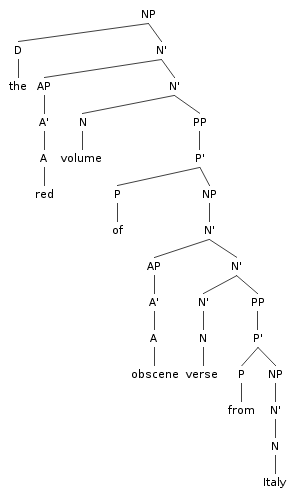
- The red volume of obscene verse from Italy
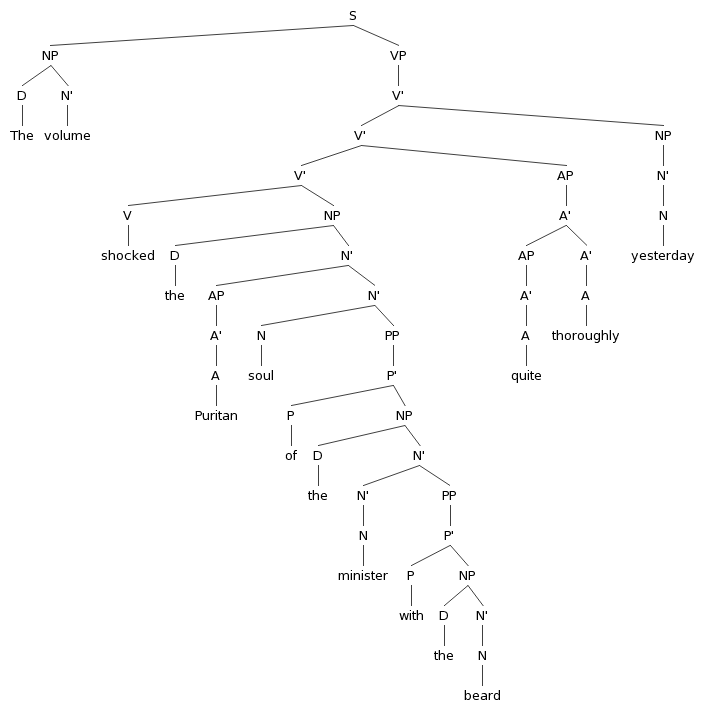
- The volume shocked the puritan soul of the minister with the beard quite throughly yesterday
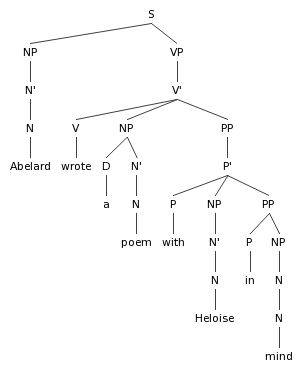

One argument for the the idea that in mind is a complement of with (obligatoriness):
-
Abelard wrote a poem with Heloise. (changes meaning)
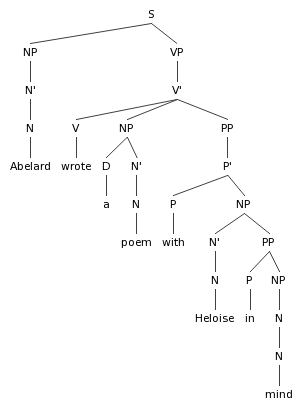
Arguments:
Chap 6
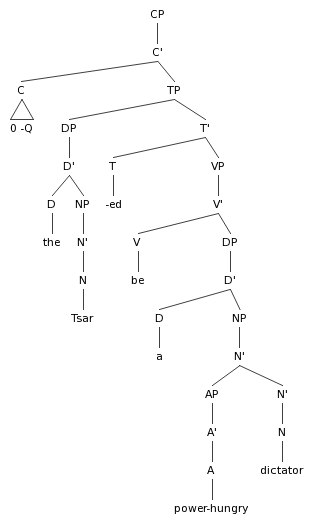
- The Tsar was a power-hungry dictator.
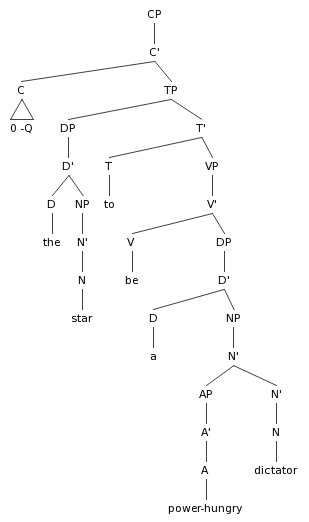
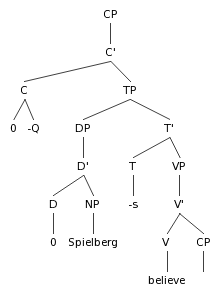
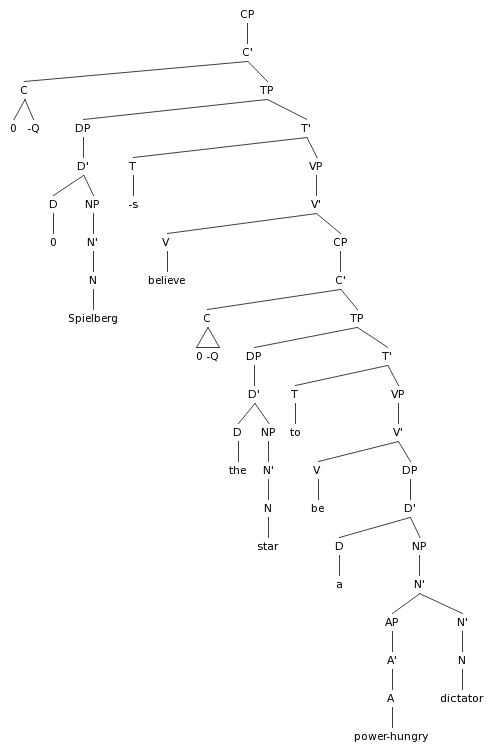
- Spielberg believes the star to be a power-hungry dictator.
-
The star was a power hungry dictator/The star to be a power hungry dictator
- John sold Mary's picture of the moon.
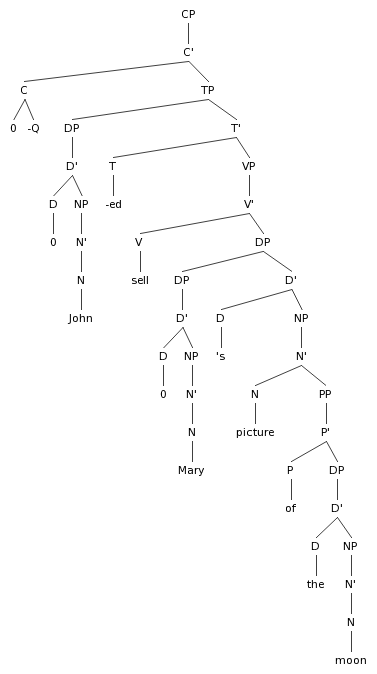
- John sold Mary's picture of the moon.
Theory
p. 99, (1)
- * Michaeli loves himi
-
Principle B violation: A pronoun must be free in its binding domain;
him is not free. It is bound by Michael,
which is in the binding domain of him; that is, it is
in the same clause.
- * Hei loves Michaeli
-
Principle C violation: An R-Expression must be free.
Michael is not free. It is bound by He.
Note: There is no Principle B violation.
The pronoun He is not bound.
Although it is coindexed with Michael
it is not C-commanded by Michael.
Therefore it is not bound by Michael.
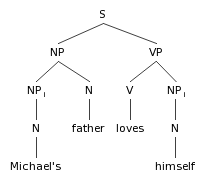
- * Michael'si father loves himselfi
-
Principle A violation: An anaphor must be bound in its binding
domain;
himself is not bound.
Although it is coindexed with Michael,
it is not C-commanded by Michael.
- * Michael'si fatherj loves himj
-
Principle B violation: A pronoun must be free in its binding domain;
him is not free. It is bound by Michael's father,
which is in the binding domain of him; that is, it is
in the same clause. (so this is really just like
example (1)).
- * Susani thinks that John should marry herselfi.
-
Principle A violation: An anaphor must be bound in its binding
domain.
Although herself is bound (it is coindexed with Susan,
and C-commanded by Susan)
it is not bound within its binding domain
(its minimally containing clause).
- * John thinks that Susani should kiss heri.
-
Principle B violation: A pronoun must be free in its binding domain;
her is not free. It is bound by Susan,
which is in the binding domain of her; that is, it is
in the same clause.
Theory
p. 100, (2)
- Johnwai [S' [S
Marygak zibunzisinok/*i hihansita ] [C to] ] itta]
-
It works nicely to assume that zibunzisin
is an anaphor. On the indexing that is
out, we would have a Principle A
violation since although
zibunzisin would
be bound, the binder is not
in the same clause. Therefore, zibunzisin would
not be bound in
its binding domain
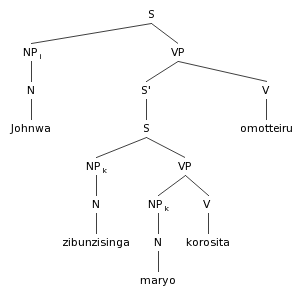
- Johnwai [S' [S
zibunzisingai maryo korosita ] [C to] ] omotteiru]
-
It no longer works nicely to assume that zibunzisin
is an anaphor. On the indexing that is
allowed, we should have a Principle A
violation but do not. Two solutions
are available. First perhaps in
this position (subject position),
zibuinzisin (or zibunzisinga) is a pronoun. There would
be no principle B violation
since the binder is not in
the binding domain (same clause). Another
possibility is the definition
of binding domain is
different in Japanese. Another
possibility is that it is the
same for English and Japanese,
but we have the definition
of binding domain wrong. In that case
not only would we need to change
the definition
of binding domain. We would
also need to account for why the direct translation
of this Japanese example is bad in English:
-
* John thinks that himself killed Mary.
-
* John thinks that him killed Mary.
-
This question can be answered
independently of
whether zibunzisin is a pronoun
or anaphor. In either case, there is a Principle
C violation here: